Jeddah's past, too, is maybe one of the most
fascinating of its features
and it goes as far back as the very beginning of the human race,
according to an
old tradition. One of the meanings of the name of the city itself
(spelled
"Jadda") is grandmother, which refers to the mother
of mankind,
Eve.
Tradition
says that after Adam and Eve were expelled from Paradise, Eve came to
live in
Jeddah and, from time to time, she visited Adam in Makkah or in Mina.
This
tradition also recounts that after Eve's death, she was buried in
Jeddah, where
her tomb withstood the ravages of the ages up until only half a century
ago when
it could still be seen from Bab Medina --one of the three main gates
which
surrounded the town up until 1947. In that year the wall was
demolished in order to expand the size of the
rapidly growing city. Since
Eve's Graveyard --as it was known-- had been venerated for so many
centuries,
people still stop and stare in awe at the place where the tomb used to
be.
Historians who are not quite so enthusiastic about
this particular
tradition, however, trace Jeddah's existence to 2,500 years ago, when
it was
only a little village, home of the Quda'a tribe which survived on the
great
variety of fish they could find in the Red Sea. The village happened to
be
located in such a strategic and convenient place that it soon grew into
a center
of commerce which facilitated trade between the Mediterranean and the
Eastern
countries. Eventually, Jeddah acquired an even greater importance when
Caliph
Othman bin Affan declared it the official port of the Holy Cities.
This, in
fact, marked a turning point in Jeddah's future not only because of new
possibilities for commerce but also because of the arrival of pilgrims
coming
from all over the world, many of whom took residence in the city.
The construction of the wall took place in order to
protect Jeddah
against the aggressors of that time, such as the Portuguese who, in
1516 AD,
laid siege to the city for three months. But, in spite of all, Jeddah
continued
growing in importance and by 1825 --now under the control of the
Ottomans--
began receiving its first diplomatic representatives from Europe
(France and
Britain). For that reason, it used to be called Bilad al
Kanasil (The
City of Consulates). It was also known as al-Balad
or just Balad, a name which it
still keeps today along with
"Old Jeddah."
RIGHT
OUT OF A
FAIRY TA
My first encounter with Balad is something I will
never forget. It was
during a vacation in 1995 when I arrived in Jeddah along with my
husband John
and two French friends, after a very long and indirect drive from
Riyadh.
We arrived late in the afternoon and were cruising
along the streets and
boulevards, fascinated by a place which was new to us. Then, just by
chance, we
came across a section of the city which was completely different from
what we
had just seen, and we stopped, dumbfounded. We parked the car and
started
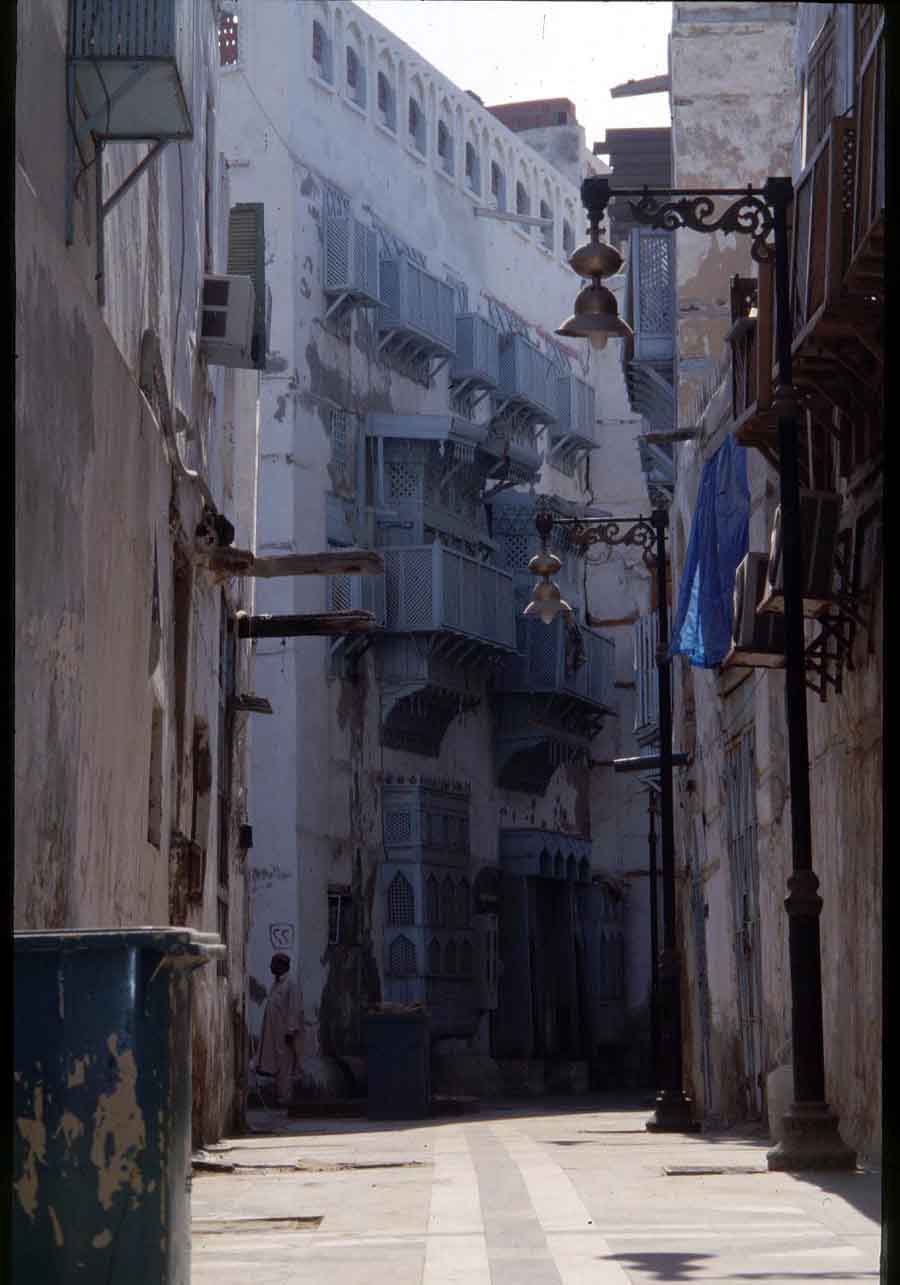
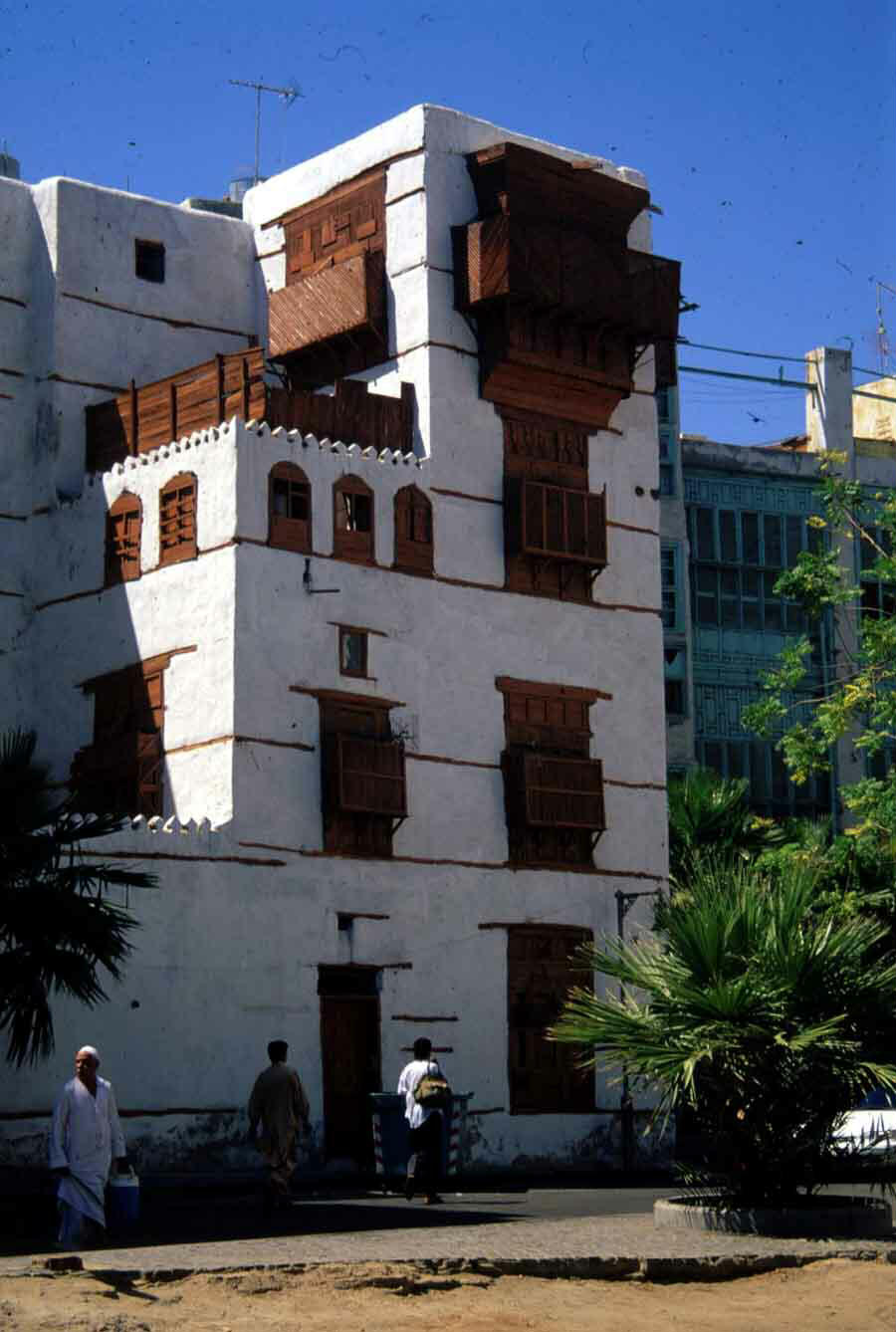
walking around this curious place, which had extremely narrow streets
with
houses that were three, four or even five stories high.
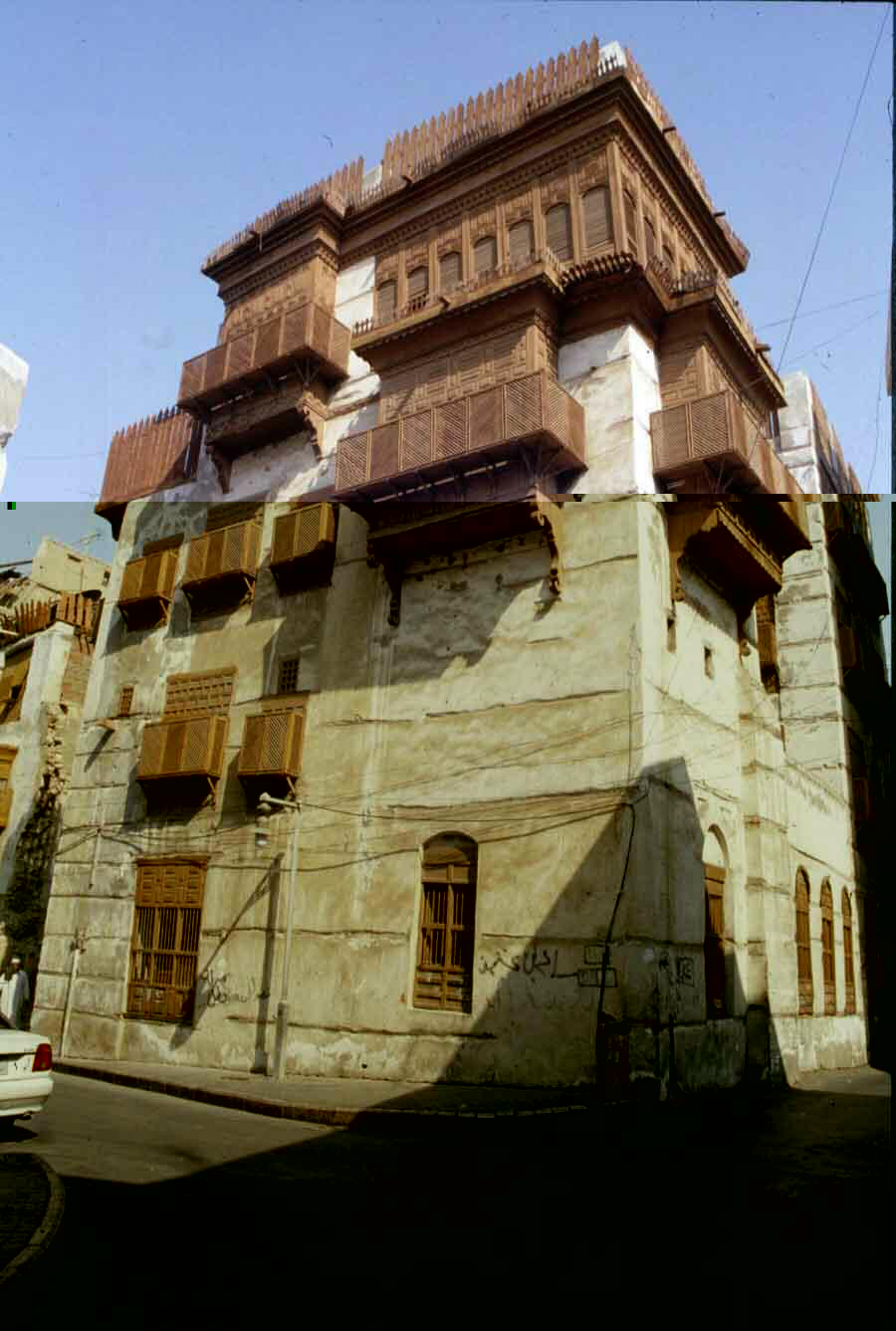
Some of the buildings looked very old and almost
ready to fall apart but
many had been renovated or just well maintained and these were
absolutely
beautiful. "How were these venerable houses made?" I asked myself.
With their horizontally embedded wooden beams they looked like gigantic
birthday
cakes divided by layers of chocolate filling! The material used to
construct
them became a real mystery too: if you touched the surface, it was not
smooth,
and if you looked close, you could see little pieces of coral and even
complete
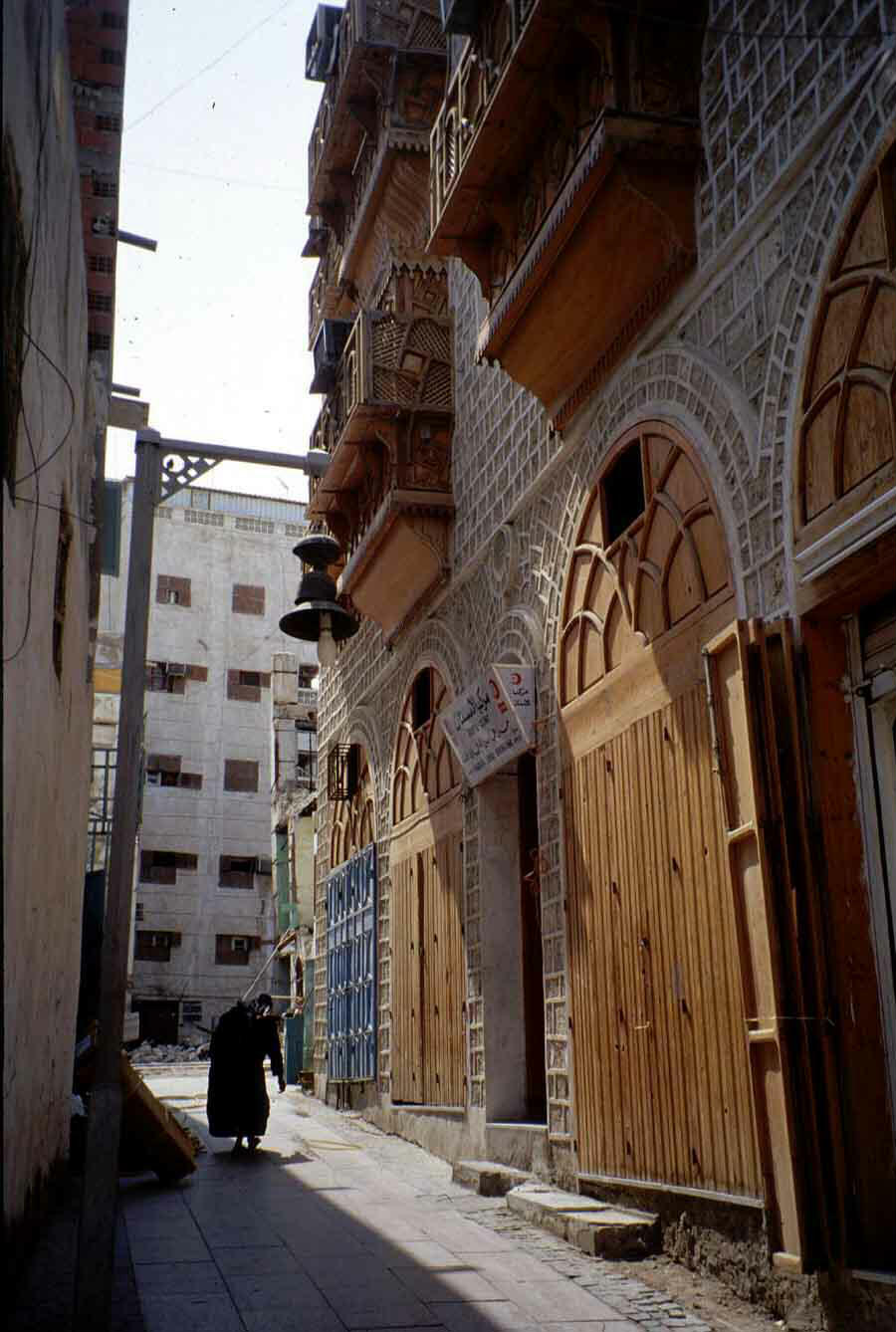
sea shells. And all of us were even more fascinated when we began to
examine the
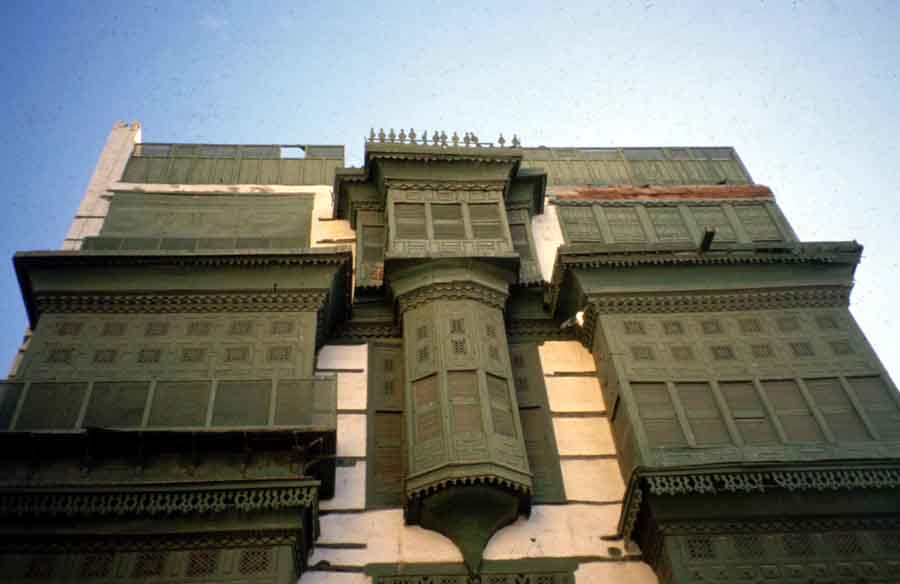
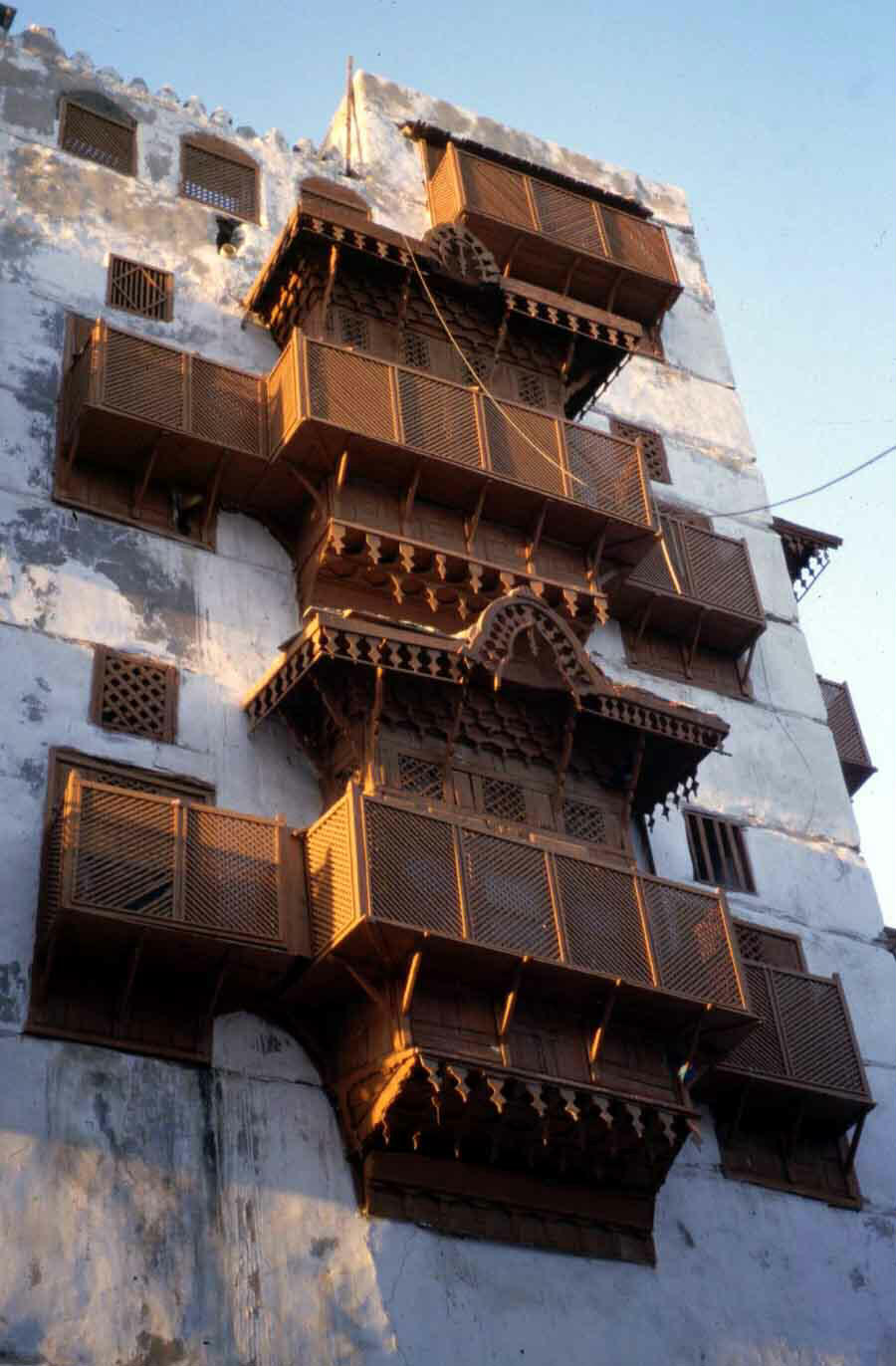
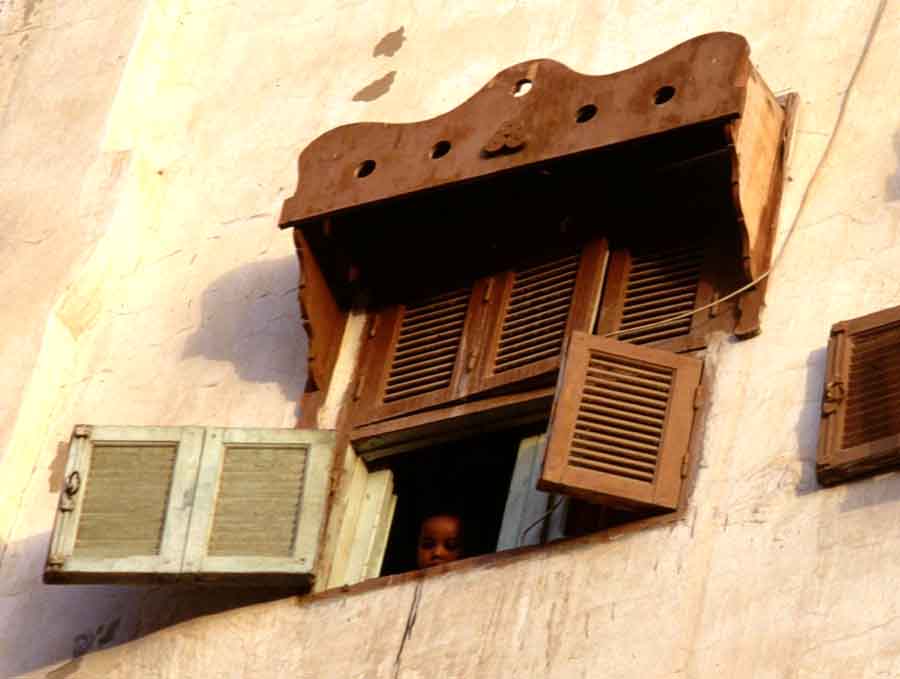
overhanging balconies made of wood which covered the windows.
[
oj6. ]Some
of them were
really big and went all the way up to the roof as if they were covering
immense
openings in the building and all of them were carved in such a delicate
and
intricate way that, rather than carved, they looked as if they had been
crocheted. Many of them showed the natural color of the wood but others
were gray
or different shades of green or blue and some were dark brown. The
doors
and the carvings around them were absolutely beautiful, too. What an
incredible
job had been done by the artisans who created such masterpieces!
"Wow! ... Where in the world are we?" We asked
ourselves. It
was as if, suddenly, we had been transported to another dimension and
had become
part of a fairy tale taking place hundreds of years in the past. "Maybe
we'll meet Aladdin and his magic lamp around one of these corners," we
joked.
We didn't meet Aladdin but we did meet what seemed
to be the friendliest
people in the country who kept inviting us to sit with them to smoke a shisha
(water pipe), or to have a cup of tea or even to eat with them. As we
were
walking in a lovely little plaza, a group of children came to us and
for some
reason decided they all wanted to give me a hug -- which they did! What
a
strange and wonderful feeling!
Later on, as we were sitting on a bench placed right
on the street for
passersby to take a rest, a sweet old Saudi man came to sit with us. He
was
right next to one of our French friends who, inspired by the pleasant
spirit of
the local people, decided to try carrying on a conversation with the
old man,
even though the two of them didn't share a common language. For ten
minutes,
they both waved and gesticulated in the air and somehow managed to have
a long
talk using just the one word kabir which means big.
This amazing exchange
culminated in the old gentleman getting off the bench, brandishing an
imaginary
sword and dancing for us. It was the very first time we saw the ardah
performed and I doubt I'll ever see anyone outdo that old man in
enthusiasm.
We were fascinated as well when we came to the souq
which was crowded with people. Obviously, many of
them were from African
countries and they wore their colorful national garb. A section of the souq
was covered and although many of the items for sale were the same as
what you
find elsewhere, it was interesting to come upon vendors sitting on the
ground
and selling things which we had never seen before, like the miswaak,
a
thin stick which serves as a toothbrush. Another vendor was surrounded
by all
kinds of baskets, brooms and other objects made of wicker, and
everywhere the
air was filled with the aroma of spices and incense.
The next morning we couldn't wait to go back to that
same remarkable
place to take pictures and by then, of course, we had learned its name:
Balad.
BUILDING BLOCKS FROM THE S
The same year (1995), my husband and I returned to
our home in Mexico,
but I always dreamt about coming back someday to explore al-Balad more
deeply
and learn all I could about it. During many years of traveling and
living in
different countries this unique spot always remained at the top of my
list of
fascinating places.
Luckily, in 1997 my husband was offered a contract
to work here and the
first thing I wanted to do was to return to Balad. There, we met
Engineer Sami
Nawar, the director of the Historic Area Preservation Department, a personne
extraordinaire who is not only very knowledgeable but also
very much in love
with his job and eager to share his knowledge with others. As he talks
to you or
answers your questions, Mr. Nawar always has a smile on his face and
more than
one joke to keep you laughing and somehow he never seems to be tired or
in a
hurry.
First, Mr. Nawar confirmed our observations about
the materials used to
construct the houses in al-Balad. The blocks contained sea shells and
coral
because they had been quarried right from the reef just off the sea
shore. The
blocks were then cemented together with a mortar made of clay found at
the
bottom of the al-Manqabah lagoon. The reason for the insertion of the
beams (taglil)
was to give better support to the construction and to permit the easy
replacement of a bad section of the walls with new coral blocks. "It's
just
as easy as changing a tire," says Mr. Nawar. The timber used for making
the
beams was brought by ship from Africa and Indonesia.
Considering the material the buildings are made of,
they seemed to us
rather frail and we suspected they might have a tendency to collapse,
especially
because they're so tall.
When we asked Mr. Nawar about this, he clarified
everything. First, he
admitted that before the right technology was found, there were
buildings which
occasionally collapsed, but once they found the right construction
technique,
there were no more problems. "As you see, the walls are thick and
strong. A
building may collapse only if it is too old and nobody cares about and
maintains
it," he explained.
"But why are the buildings so tall," we asked. In
short order,
we discovered there were several good reasons for this. One of them was
the
summer heat: relaxing atop a high roof, people could find extra comfort
from the
gusts of an evening breeze. Another reason is the shade the buildings
produce,
which is much appreciated by the people walking on the streets
especially, of
course, during the hot months of the year.
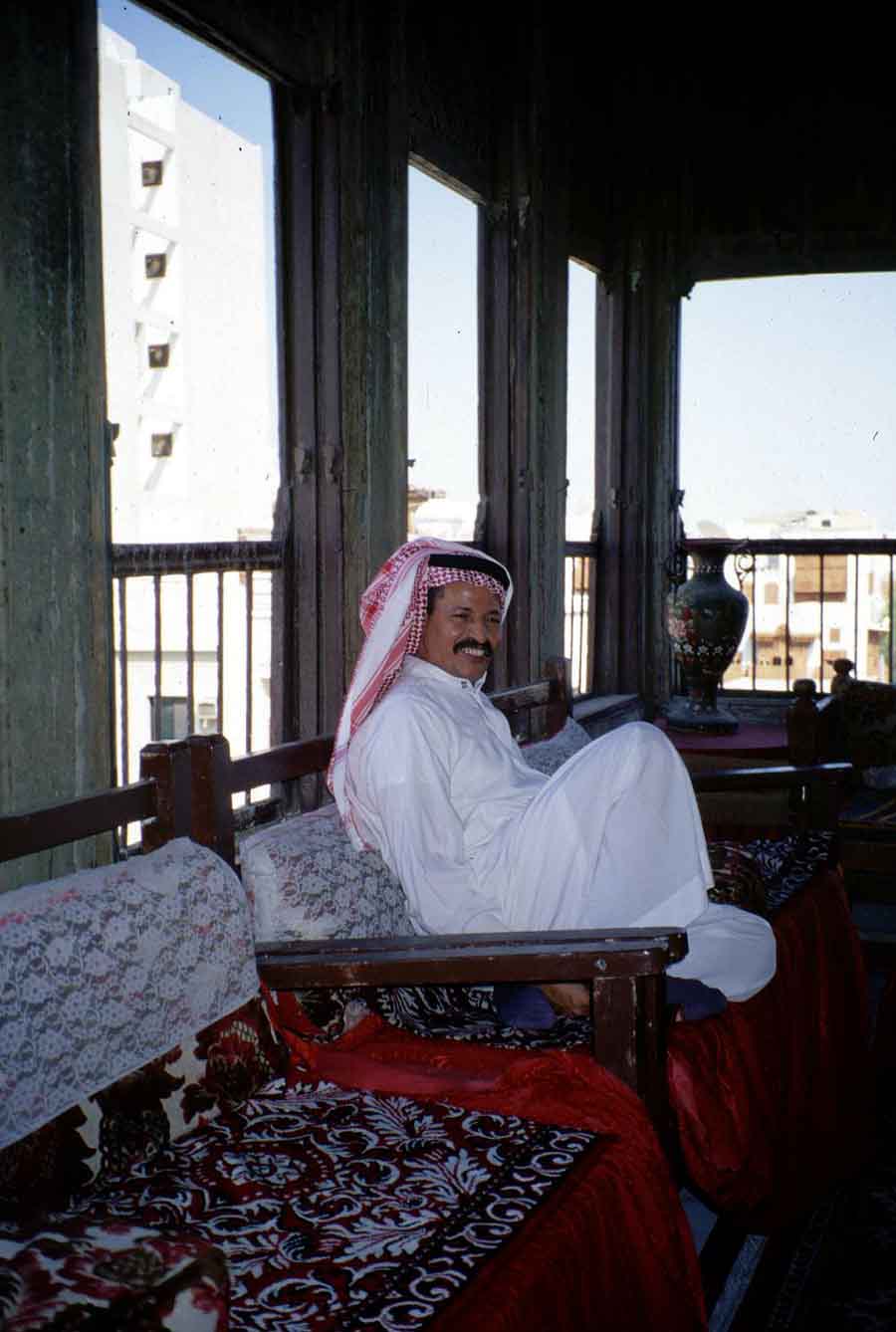
The
balconies, too, had a
lot more to contribute to the buildings than their beauty. Besides
helping to
block the sunshine, they were designed to catch the breeze which is
then
transformed into air currents moving throughout the house, providing
good
ventilation and comfort, again, a real necessity during the hottest
part of the
summer. Moreover, the wood was carved in such a way that it was easy to
look
outside while remaining hidden from public view.
Some of the balconies, the rawashin
(singular: roshan) had a very
particular use because the part that
juts out over the street was used as an extension of the room and was
filled
with comfortable cushions where people could sit directly in the path
of the
evening breeze. The ones with beautiful designs were called mushrabiyah
and the ones resembling simple, practical grills used as windows are
called shish.
The latter were most commonly used on the sides of the houses.
These houses were constructed for the rich merchants
and some are as many
as three or four hundred years old, mostly worked on by artisans who
had come as
pilgrims and for one reason or another, didn't go back to their
homelands. In
those days, camel caravans were the only means of transporting goods by
land.
Now, we might imagine that it was very romantic to be in a caravan
slowly
winding its way among the dunes of the big deserts and then climbing
high into
the hard, volcanic mountains. In reality, however, it was extremely
difficult
and dangerous. If thirst and sandstorms didn't do you in, the bedouin
raiders
were always near at hand, eager to
get
their hands on the precious merchandise which included spices,
frankincense,
plants for producing medicine, etc. In the city of Jeddah itself, life
was
rather harsh too because of the absence of essential commodities such
as
drinkable water which had to be brought to the city by donkey or by
camel from
Wadi Fatima which is 40 kilometers away. A much less reliable source of
water
was that which could be collected in cisterns from the scarce rains.
Recently,
an underground filtration gallery (qanat) was
discovered in the heart of
Balad. This tunnel brought water to the city from the nearby mountain
ranges.
The qanat was used up until about 112 years ago and
is about 500 years
old. It is said to have played a key role in withstanding the
Portuguese siege of 1516. The most recent source of water comes from
desalination plants.
BAYT NASSIF
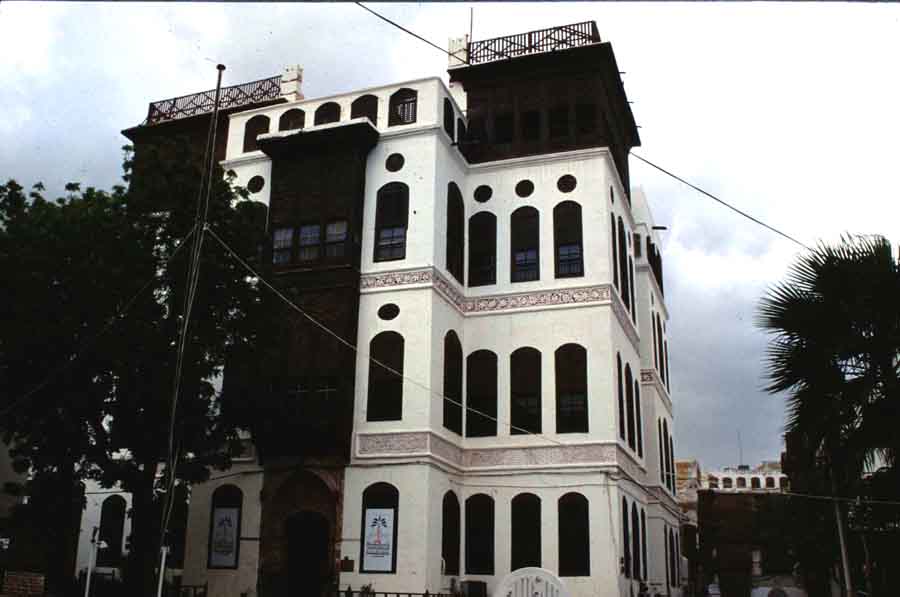
One of Balad's most magnificent ancient mansions,
which has recently been
renovated, is Bayt Nassif (Nassif House), now considered a symbol of
Jeddah's
rich past. Today, it is a cultural center where you can attend special
exhibits
or lectures given by knowledgeable people like Mr. Sami Nawar. Going
from one
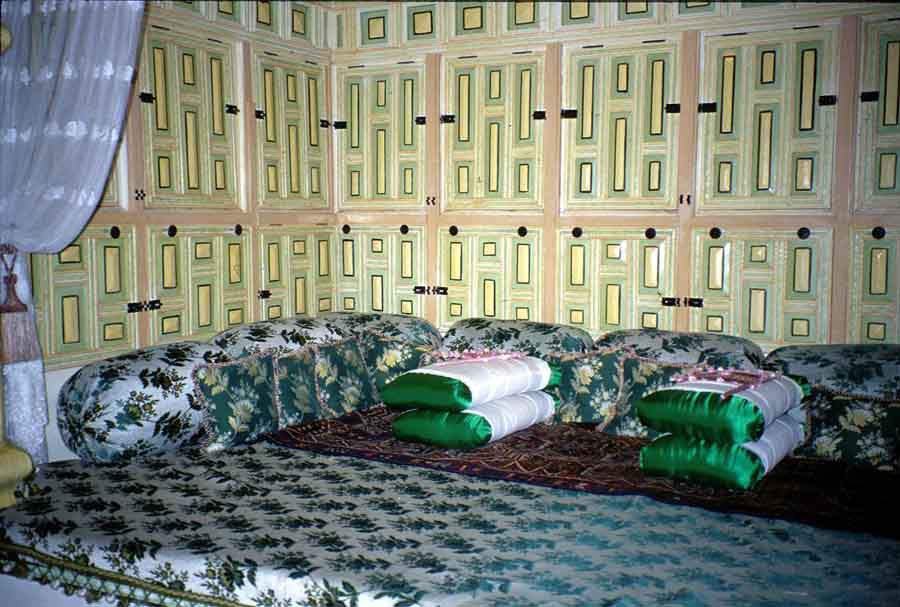
room to another one can also learn a lot about what the interior of one
of these
houses was like in bygone days. Something which I found especially
interesting
was that they used trained camels to go up and down the five floors of
the
building carrying goods, especially to the kitchen on the fourth floor.
The
stairway is, in reality, a ramp with spaced crossbeams, convenient for
both man
and beast to walk on.
Bayt Nassif has 106 rooms and the art work some of
the rooms contain is
admirable. Besides works on wood, you can see others on tiles as well
as Arabic
calligraphy.
There is an interesting anecdote related to how
large and complicated
this building is: On one occasion, a thief entered the house, not with
good
intentions, of course, but in the course of his wanderings, he realized
that he
was completely lost. He spent so much time trying to find his way out
that he
eventually lost his nerve and when someone finally came across him, he
immediately surrendered, begging to be arrested!
People used to recognize Bayt Nassif as "The House
with the
Tree" because it was the only house in Balad that had one. Obviously,
growing a tree was not an easy task because of the scarcity of water.
This hardy
survivor is a neem tree (Azadirachta indica) and is practically as old
as the
house.
The construction of Nassif House began in 1872 and
it was finished by
1881 for Sheikh Omar Effendi Nassif, then governor of Jeddah. This
house
belonged to the Nassif family until 1975. One of the heirs, Sheikh
Muhammad,
turned Bayt Nassif into a private library that eventually accumulated
16,000
books, which could be read by anyone visiting him. Today these books
belong to
the Abdul Aziz University Library.
Although
nowadays one can enjoy all the commodities of modern
life, it's still a very exciting experience to wander through Balad,
admiring
the houses, both old and renovated, perhaps attracted by the sight of a
beautifully carved door or an ornate balcony and eventually discovering
that you
are lost. But getting lost among streets with such history, such beauty
and such
charm may well be remembered among the most pleasant mistakes of your
life.