| THAT'S NO HOT AIR - Mahmoud
Alshanti harnesses the powerful (and cool) airflow of the
Munbateh blowhole..
|
 |
© 2005 by John and Susy Pint -- Updated September, 2013
| THAT'S NO HOT AIR - Mahmoud
Alshanti harnesses the powerful (and cool) airflow of the
Munbateh blowhole..
|
|
On our last visit to the caves of
Habikah in Northern Saudi Arabia, a soldier had led us to a small,
strongly
blowing hole which we hoped might be connected to a vast cave beneath
the
desert.
On
May 13, 2001, a small team set
out to have a good look at the Munbateh blowhole and possibly penetrate
its
secrets. Mahmoud Alshanti and I were joined by Susy Pint, who would be
heading
out to the desert for the first time since her return to Arabia.
| We drove from Ar Ar to the little village of Abu Ruath and from there due south to Munbateh. The tracks were not quite as "kula wahed" (All going the same way) as Mahmoud imagined and we frequently found ourselves with no track at all. But this just increased our chances of finding spiny-tailed lizards, known as dhubbs... | 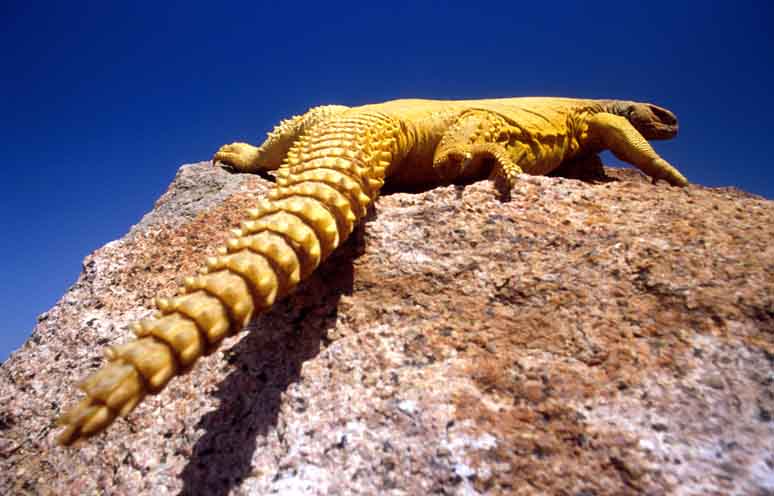 |
Every time
we
found a dhubb, we had
to slam on the brakes and
run out to catch the unlucky beasts. Susy declared that this is more of
a
machismo rite than anything else and I suspect she is right. At any
rate, as we
drove along, two captured dhubbs were
unceremoniously tossed into the back of
the Land Cruiser where they immediately disappeared under all the
camping and
caving gear. As we drove along, more than once I imagined I could feel
the hot
breath of a dhubb on the back of my neck and I
fully expected to have an ear
nipped off before the end of the ride.
 |
As evening
approached, we arrived at
Munbateh. The blowhole is located at one end of a shelter cave in a
depression
about two meters deep in a flat area offering absolutely no shade. As
soon as we
had arrived, set up camp and tied up the dhubbs, we
went to see if the hole was
still blowing cold air. Well, it was doing a better job than most floor
fans but
we had no sooner entered the shelter cave when we got thoroughly
distracted by a
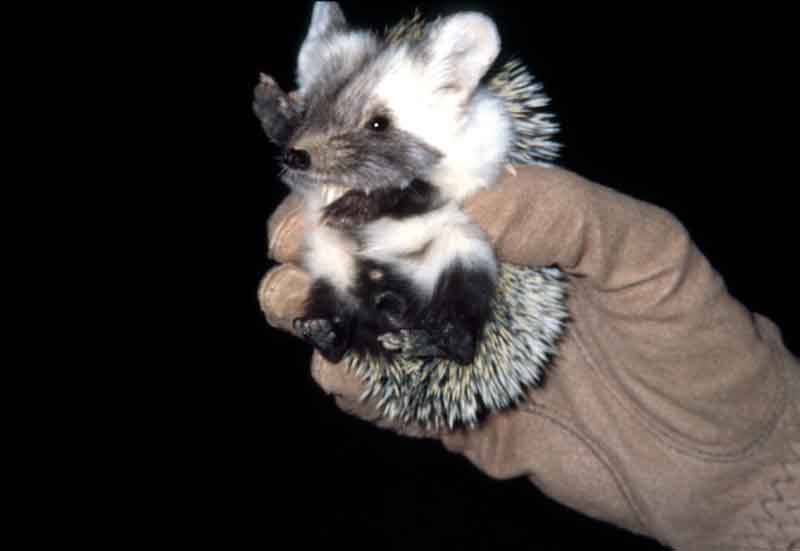
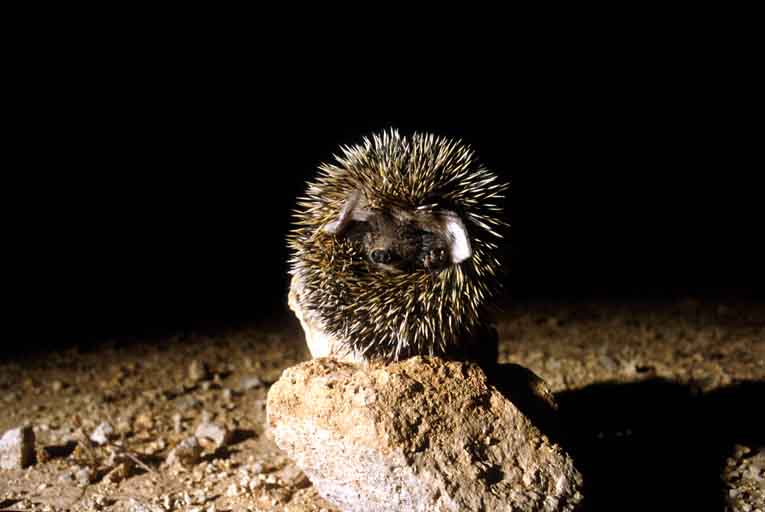
little creature we found sitting there enjoying the natural "AC." It
was a young hedgehog (gonfud, in Arabic) which
immediately rolled up into a
prickly ball about the size of an apple. After a while, however, we saw
a tiny
nose peek out and soon small, delicate paws appeared which looked like
tiny
hands. Soon Mahmoud had tempted the little guy to munch on bread crumbs
and it
seemed happy to receive endless attention from Susy who rated it five
stars for
cuteness.
|
|
After a
delicious meal prepared by our
driver Hamadi, we put Gonfud (as we called him from then on) into a box
and hit
the sack. The temperature was pleasant and the place was dead quiet.
However, at
three AM that morning a powerful wind suddenly hit our tents, causing
an uproar
of flapping and shaking. After half an hour it stopped. Since I was now
awake, I
got up to have a look at the cave entrance as I had my doubts about the
Bedouins' claim that "It always blows." On my way to the hole, I
spotted Gonfud's box. It had been turned over by the wind and the
little
hedgehog was gone. I continued to the cave entrance and discovered that
the hole
was now sucking air, more noisily
than
when it was blowing. In other caves, this in and out movement has
always
indicated a large space containing air under more or less pressure than
on the
surface. Since Dahl
Sultan does the
same, but maybe only a tenth as strongly, I figured we could find
passages below
at least ten times longer than Sultan's. The discovery that Munbateh is
another
of these "breathing" holes may add weight to this hypothesis.
Then I
shone my light around the
shelter cave next to the blowhole and what did I spy but little Gonfud,
peacefully sleeping on a tiny ledge 'way in the back while just nearby
him
frolicked a really beautiful, fat, light brown country mouse who wasn't
at all
bothered by my light. I clambered up the slope and was stopped dead in
my tracks
by a loud hiss coming from right in front of me. I had forgotten all
about the
dhubb Mahmoud had tied there (the other one had already escaped) but
the dhubb
had obviously not
forgotten about
me!
I went back
to bed and dreamed a dream
in which we three explorers were wearing ski masks and goggles,
crawling forward
against a mighty wind. The tight crawlway we were in twisted and turned
and
brought us to an opening at the top of a vast chamber dripping with
stalactites,
giant shields and rippling flowstone. It looked a lot like Lebanon’s
famous
Jeita Caverns. Off in the distance a deep river could be seen (somehow
I knew it
contained pleasantly warm water) and beyond stretched passageways that
continued
forever.
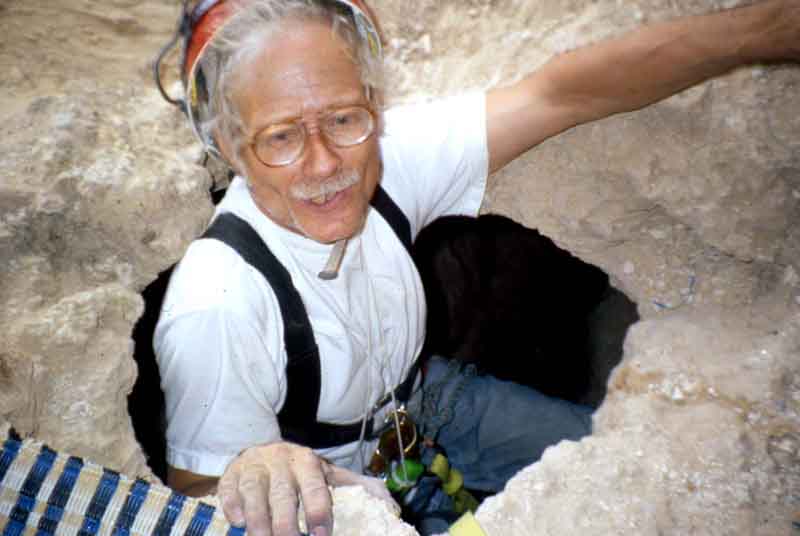
The reality turned out a bit different. After breakfast I crawled into the blowhole -- no ski mask or goggles required...
| ...Inside,
I found a smooth, slippery downsloping tube which led to a vertical
drop over a room only a few meters below. We ran a rope from the car,
through the tube and down into the lower room. Then Mahmoud and I
rappelled in... As you can see from my hair, the hole was blowing when this picture was taken... |
 |
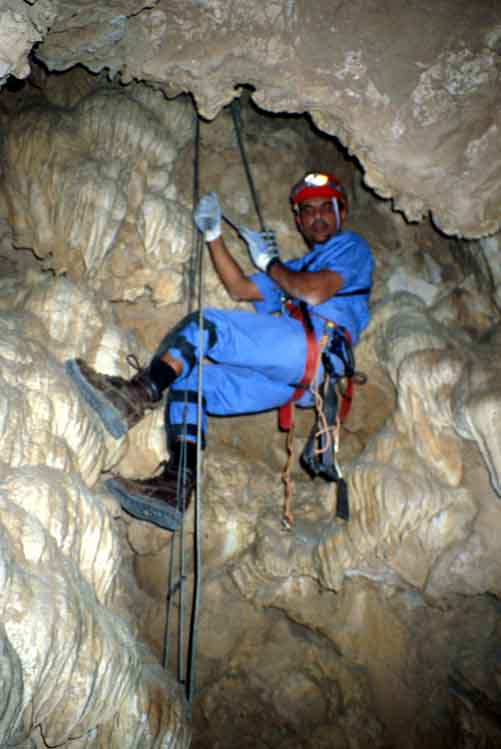
A
rectangular-shaped room lay below, filled with great chunks of
breakdown from
end to end. The entrance tube and the area just below it were covered
with white flowstone, but
elsewhere there were precious few formations to be seen. A
layer of white powder about a centimeter thick covered
most surfaces in
the room. Without a doubt, we were the first people ever to step into
that place
and disturb the fine powder, which appeared to be gypsum. However, we
felt very
little satisfaction over this privilege because the whole scene looked
more like
the aftermath of an earthquake than the entrance to a grandoise cave.
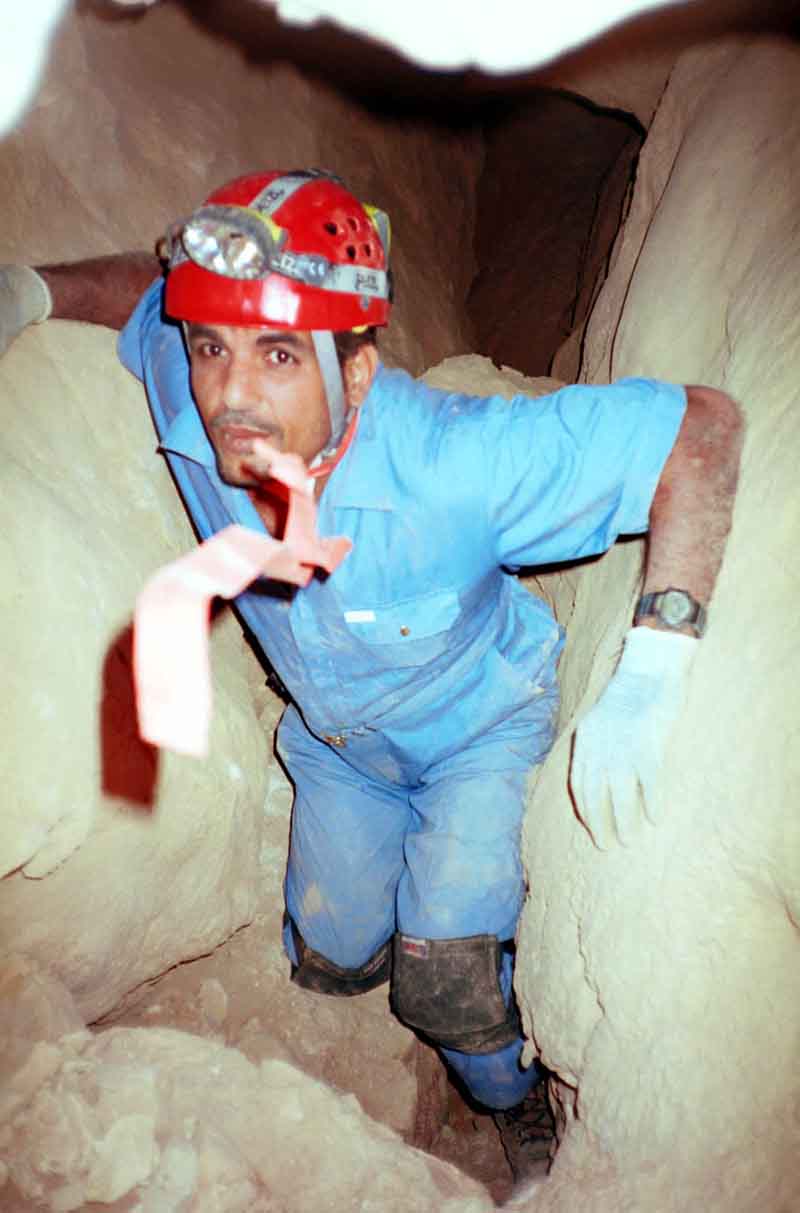
Mahmoud entering the Powder Room. Taken with a point-and-shoot camera that didn't want to focus on the right spot (Mahmoud's nose, of course).
|
 |
Indeed, we had to be extremely careful negotiating our way among the jagged, precariously balanced rocks in search of passages leading out of the room. This investigation was not helped at all by the fact that the airflow had slowed down to zero. It was the moment of transition between sucking and blowing and it left us with no way to locate a possible connection between this room and the elaborate cave system that might lie beyond. Tight crawlways we did find, at all four corners of the cave, but they had the look of fragile cracks, not smooth, friendly cave passages and neither Mahmoud nor I felt enthusiastic about wriggling into such unstable looking places. Maybe if we had felt a strong breeze from one of the holes, we would have chanced it, but both of us were uncomfortable with this Powder Room and we advised Susy not to bother coming down. After taking a few measurements, we returned to the surface, sorely disappointed, I must admit.
However, we still had several options available to us in our search for the Big One. On our way to Munbateh we had spotted and taken the coordinates for a hole with a nice cool airflow. It looked like an easy, horizontal cave and was located just a few kilometers away, so off we went to check it out.
|
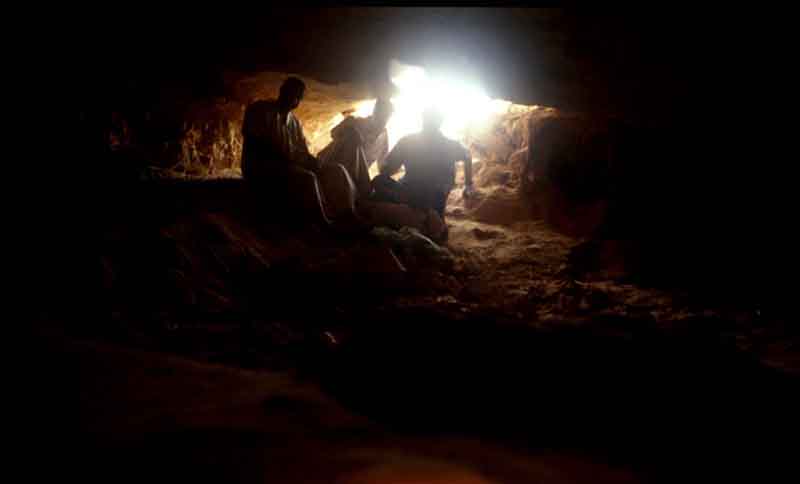
Mahmoud had named it Kahf Al Najimah
(Star Cave). The small entrance hole opens onto a very wide room with a
low ceiling, just low enough so you can rarely stand up and therefore
irksome. Moreover, the dank air reeked with the musky smell of
animals... |
 |
"There are
wolves in here," declared Mahmoud as if there could be no doubt. It was
definitely a creepy place and it took some gumption to forge ahead.
After a few
steps, we spotted fox tracks and then near some very old-looking
stalactites and
columns, we came upon a pile of bones which looked like they'd been
recently
gnawed on. About 40 meters inside, we found huge slabs of breakdown
which
reminded us of those in Munbateh's Powder Room. Among these there was a
great
slab of rock that seemed to be balanced on its side, held up by a
fragile finger
of stone. It looked like all we had to do was kick away the prop and
have 20
tons of rock fall on us.
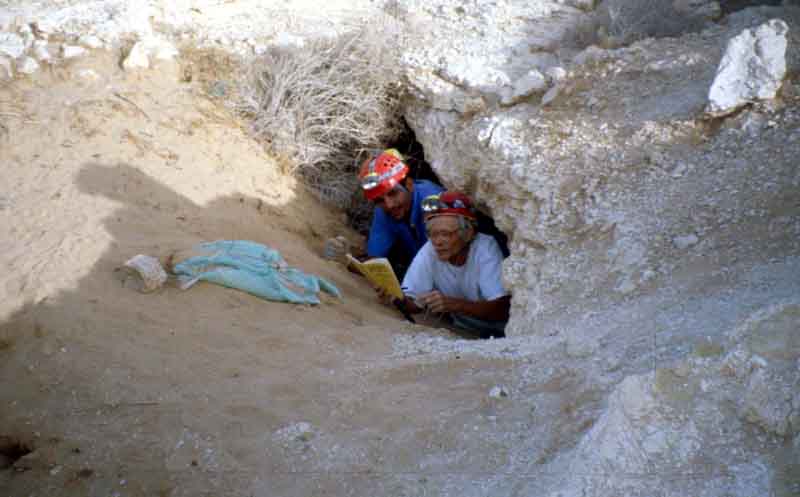 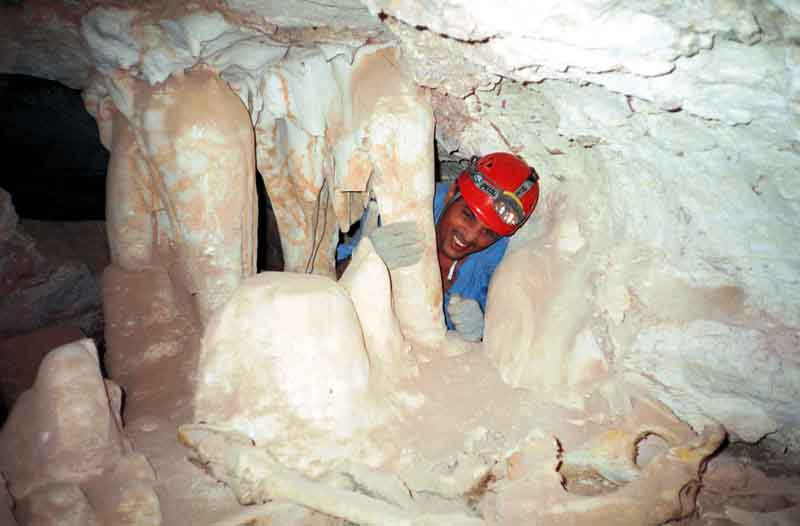 On the left, one
of the two entrance holes to Star Cave. On the right, you can see
Mahmoud among some old columns in the cave, attempting to defy the laws
of nature. You never should have eaten that candy bar, Mahmoud! On the left, one
of the two entrance holes to Star Cave. On the right, you can see
Mahmoud among some old columns in the cave, attempting to defy the laws
of nature. You never should have eaten that candy bar, Mahmoud! |
 |
At the back of this room, we found a
sort of doorway. Cold air was literally roaring out of it, much
stronger than at
Munbateh. We were amazed. Since this opening is maybe eight times
bigger than
Munbateh's, it gets the medal for strongest-blowing hole in Arabia (so
far). I
looked into this doorway and found a large rock resting atop a deep
fissure.
Near me, the fissure was only about a foot wide, but it grew
progressively wider
in the distance, so much so that chimneying would be impractical and
dangerous.
At a distance of less than ten meters, the fissure seemed to end at a
hole
heading straight down. I was sure this was the doorway to my dream
cave, but how
could I proceed without the risk of falling into the crack? Even if I
were
belayed, I could end up stuck down in the fissure. Now I am sure a
rock-climber
could negotiate this tricky bit, but less talented folks (like me)
would need a
traverse line. Once again, I came to the conclusion that what we needed
were
bolts or pitons but, of course, we had none because never before in
Saudi Arabia
had we encountered a rigging situation we couldn't solve with a rope
tied to our
car. Just standing at the Star Gate, staring into that passage, I got
so cold I
began to shivver, so we went out to get survey gear, realizing this was
an
important find, and we mapped all of Star Cave that we could.
|
With
Susy Pint eyeballing on the sideline, Mahmoud is lining up the Disto
with the surface. It's the second time we've used this handy digital
measuring device for cave surveying. This gizmo makes it a snap to take
up, down, left and right measurements at every station in a matter of
seconds. |
 |
|
|
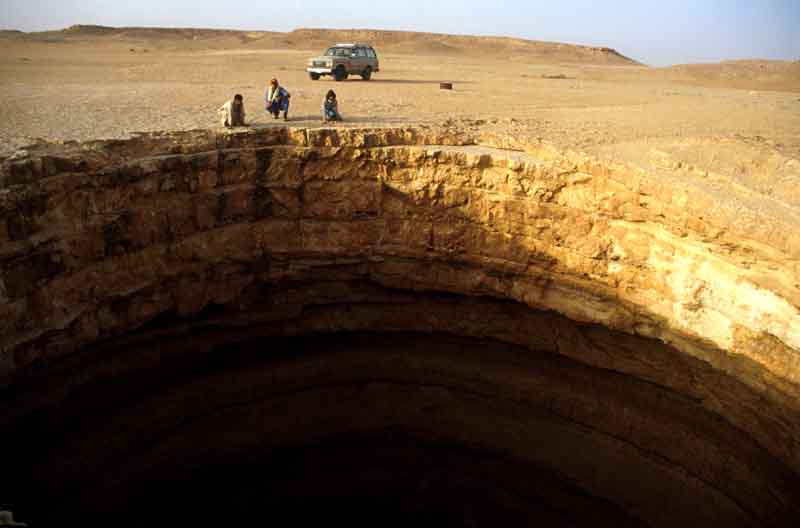
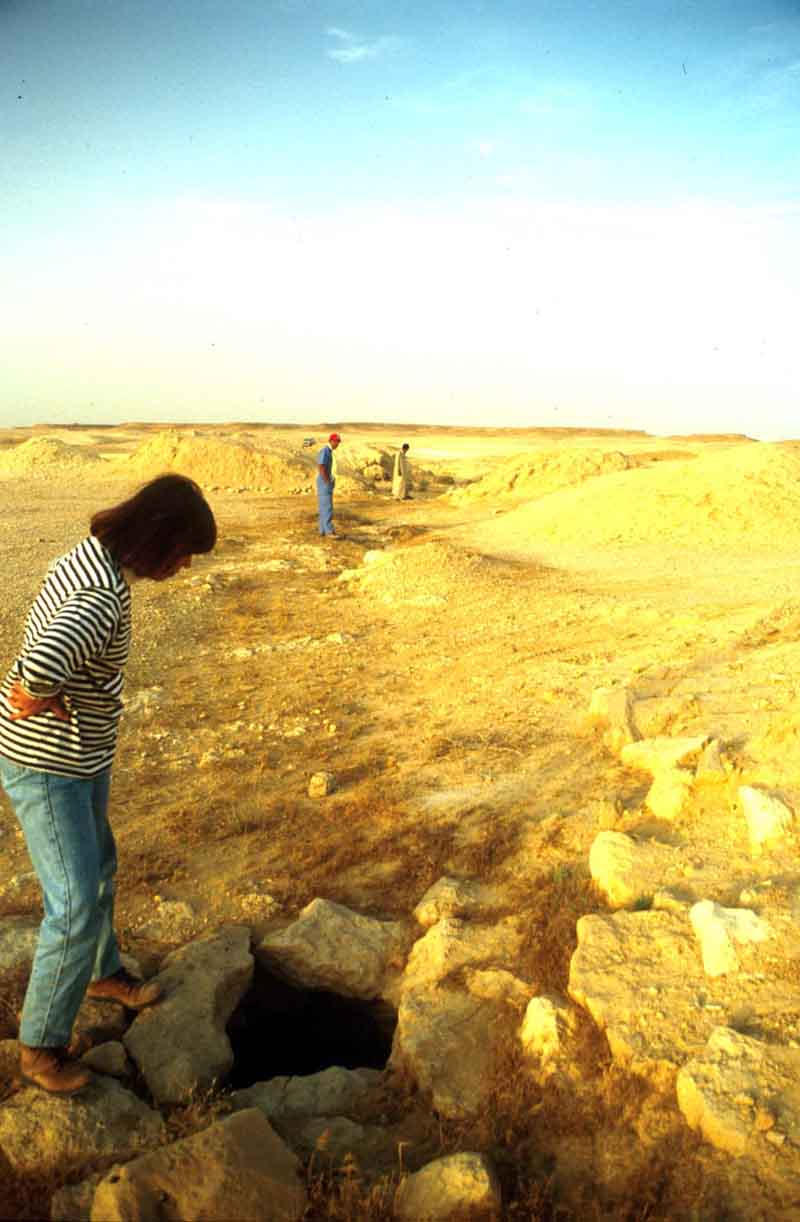
At this point Khalid Otaibi, our soldier guide, showed up and we went with him to have a look at the huge dahl at Kfaitan. This hole is only 28 meters deep but it's almost perfectly round and one of the most impressive pits in the country. This one, at least, should be easy to rig. Just near the dahl are the ruins of a village abandoned within the last 100 years. Here we found many "water wells" according to Khalid, who believed they were used to catch channeled rain water. He says there are over 40 of these in the area. To Susy and me, they appear to be entrances to a qanat, an underground aqueduct often used in the Middle East. This technology was eventually carried to the new world by the Spaniards. See Qanat La Venta under Reports at www.saudicaves.com.
|
The round holes at Kfaitan are spaced 11 to 12 meters apart, just as in the qanat we found in Mexico and many are in a perfectly straight line. Heaps of dried mud alongside them hint that the qanat got silted up and maybe that is what finished off the community that once lived here. Each
person in the picture is standing above a hole penetrating the hard
limestone. |
 |
It would be interesting to know what an
archaeologist or a historian would have to say about this place. After
looking
around, we returned to camp and had fun playing with Gonfud the
hedgehog.
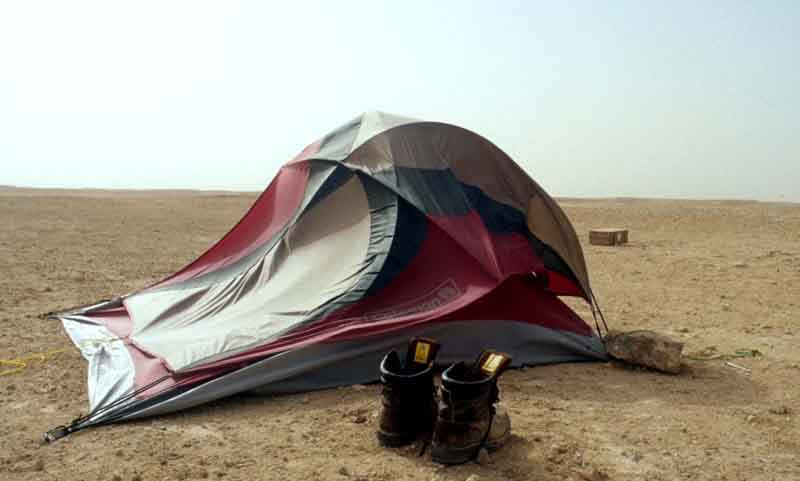
During the night, the wind picked up
and steadily grew stronger, straining our tents to their limits. "My
tent
was practically flat and one wall was right on top of my nose all night
long," complained Mahmoud, who got no sleep at all. Meanwhile, with
earplugs and eyeshades in place, I slept like a baby, not realizing
that Susy
had been battling the tent wall, like Mahmoud, all through the night. I
owe you
one, Susy!
|
|
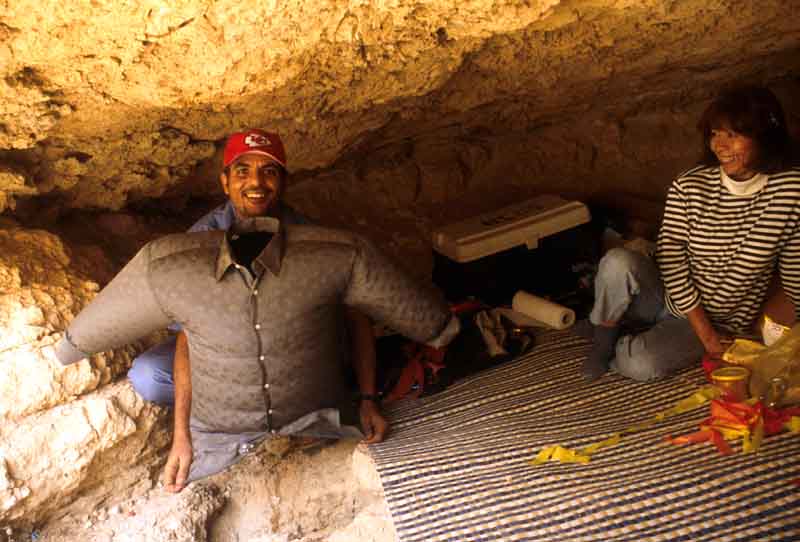
Next morning we noticed that the
Munbateh hole was blowing much more strongly, apparently due to the
wind
whistling outside (moving air probably creates a vacuum over a
depression.) The
combination of strong wind and burning sun left us no choice but to
prepare
breakfast inside the shelter cave. While we worked on this, we also
attempted to
measure the strength of the airflow from the blowhole, which shifted
from
sucking to blowing while we were breakfasting. Dahl Sultan, we figured,
had the
force to lift a Kleenex but probably not a ghoutra (head cloth).
Munbateh, we
soon discovered, could support a whole box of Kleenex, unopened, and in
fact, we
couldn't get the box to fall into the hole for anything. Soon we had a
variety
of small objects bouncing around in the stream of air. This, however,
we judged
to be an "abnormally strong" state, influenced by the strong surface
wind or possibly a momentary low pressure zone in the area. To
calculate cave
volume by airflow, one would surely have to factor in the changes
affecting air
pressure on the surface.
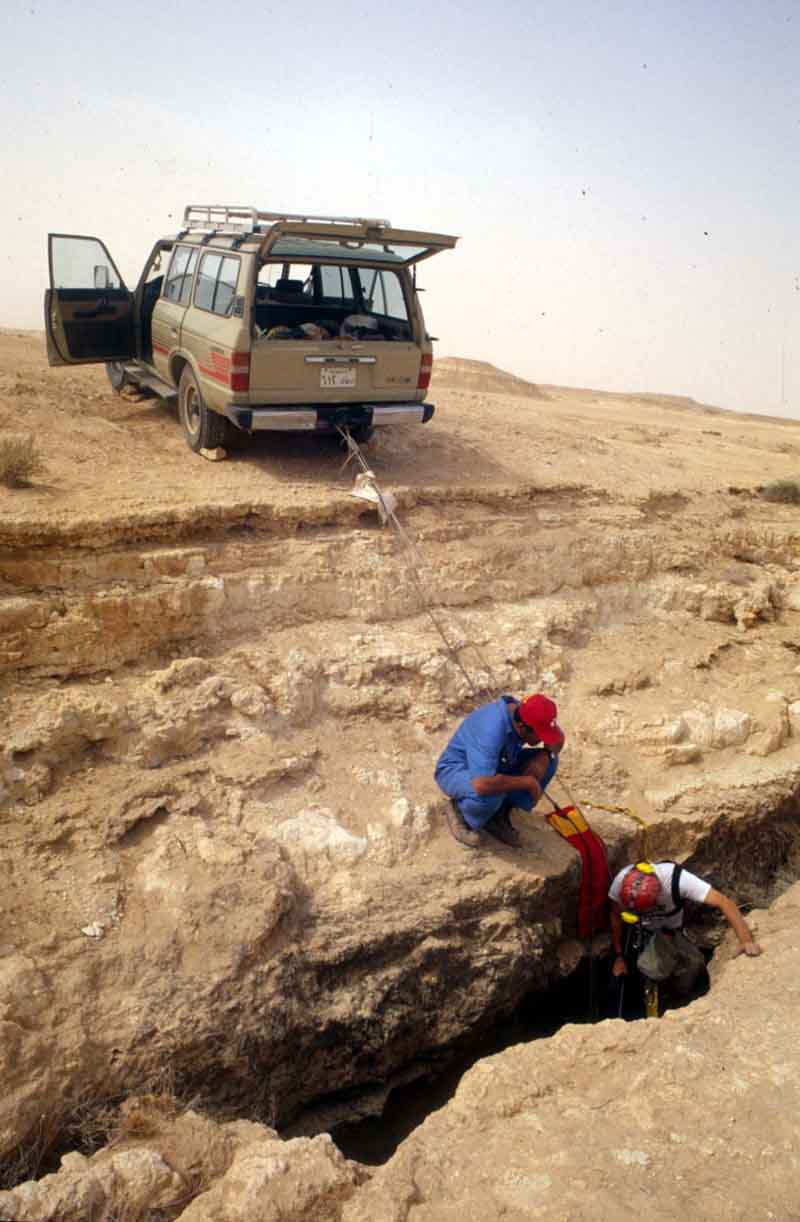 We
still had one last chance to find
our Big One. After breakfast, we traveled a whole 300 meters over to
the
Munbateh Fissure, which also blows cold air with gusto. This crack is
about 12
meters deep. I rappelled down only about four meters to a spot where
the crack
is too narrow to permit passage. Just one meter over to the side, the
space is
wider, but once again we were stymied by the need to put a bolt there
to allow
us to move the rope over to the right side. Without a deviation of some
sort,
you would come back up the rope to a crack you couldn't fit through. So
we
derigged, broke camp and headed back towards Ar Ar. But our exploring
was not
quite finished...
We
still had one last chance to find
our Big One. After breakfast, we traveled a whole 300 meters over to
the
Munbateh Fissure, which also blows cold air with gusto. This crack is
about 12
meters deep. I rappelled down only about four meters to a spot where
the crack
is too narrow to permit passage. Just one meter over to the side, the
space is
wider, but once again we were stymied by the need to put a bolt there
to allow
us to move the rope over to the right side. Without a deviation of some
sort,
you would come back up the rope to a crack you couldn't fit through. So
we
derigged, broke camp and headed back towards Ar Ar. But our exploring
was not
quite finished...
|
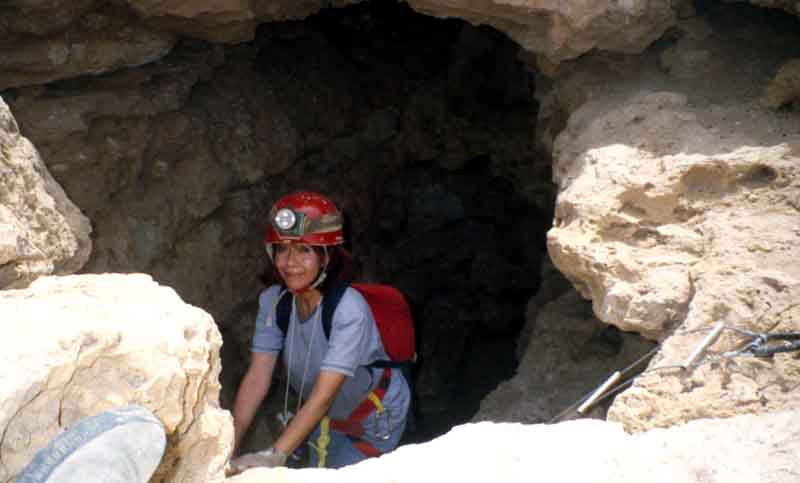
Khalid Otaibi had given us a set of cave locations found by a friend of his and one of these just happened to be right along our route. Its name is Kahf Al Makr, which means Clever Cave and it turned out to be quite interesting.. Susy preparing to climb down to the first level. |
 |
Not
so clever was a message on the wall just above the two-meter
entrance drop. The sprayed writing proclaimed that "There is gold in
this
cave." This marks the first time in Saudi Arabia that I've seen signs
of
treasure hunters in action.
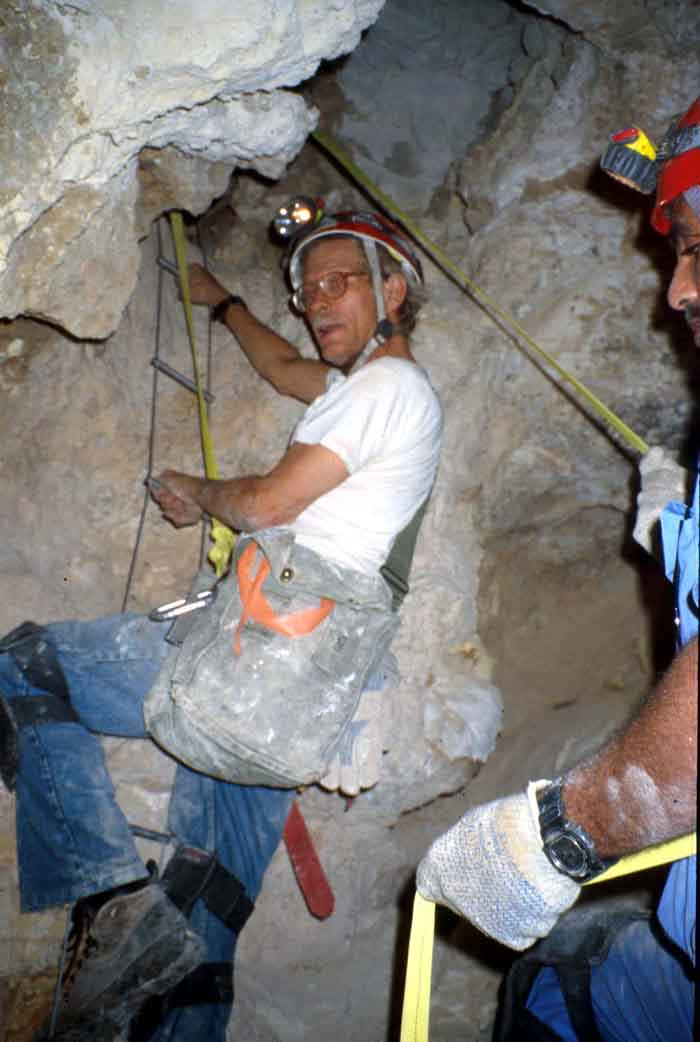
We attached a cable ladder to the car
and climbed down to the first level of the cave, a horizontal passage
which had
an area covered with smooth, white gypsum and off to one side a
people-sized
hole leading to a lower floor, again about two meters below. Here we
found a
passage going both ways. In one direction, we came to a pool of water
several
meters in diameter. We've not seen anything similar in the
Ma'aqala-Shawiah
area, but in the
book Out in the
Blue, Tom Barger indicates that as recently as the 1930s
bedus in that area
could find pockets of water just like this. Deep rope grooves in pits
like Dahl
Hashami suggest that standing water could be found there over a long
period of
time, whereas today, the most you could hope to see would be a tiny
puddle such
as the one Dave Peters found at the end of Hashami's horizontal
passage. It will
be interesting to see how many dahls of the far north contain pockets
of water.
|
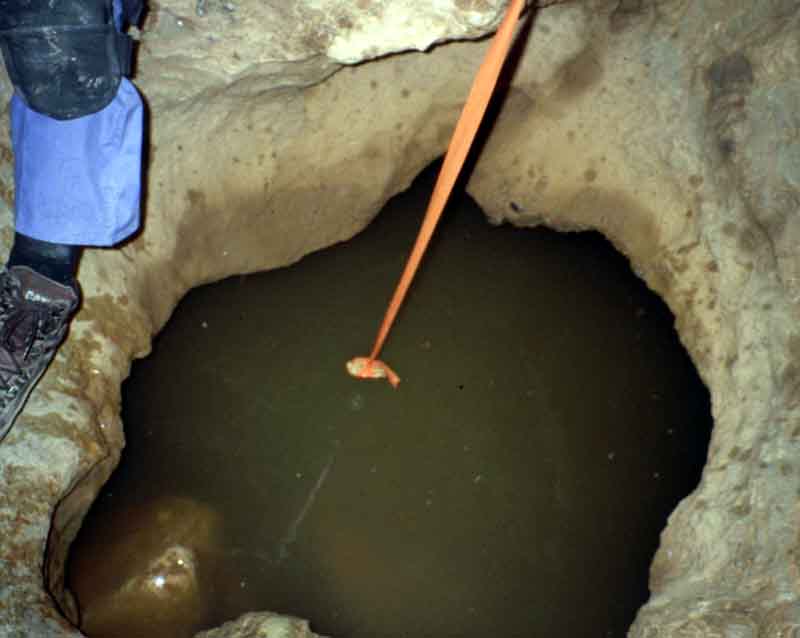
The water in Makr is at least a meter deep and it appears we were looking down through a hole into a much wider pool. The situation needs to be investigated, because if this pool extends for a great distance, it could be a useful resource and a “treasure” indeed...
|
 |
We had no
time to check this out, but by jumping into the pool, we will see how
much air
space there is between the water surface and the roof. At the other end
of
Makr's second floor we found a slope leading down to a third level.
Unstable
breakdown makes this slope a bit dangerous and we had run out of time,
but this
next level would be well worth a return visit, even though there was no
hint of
blowing air.
So it was that all of us, including
Susy, got to explore a quite nice cave at the very last moment of our
trip. If
the rest of Khalid Otaibi's leads are like this, we cavers have plenty
of work
ahead in the area south of Abu Ruath. And, who knows, maybe next time
we’ll
finally wander into The Big One.
John Pint